Thinking Process
PHASE 1: VISUAL DECONSTRUCTION
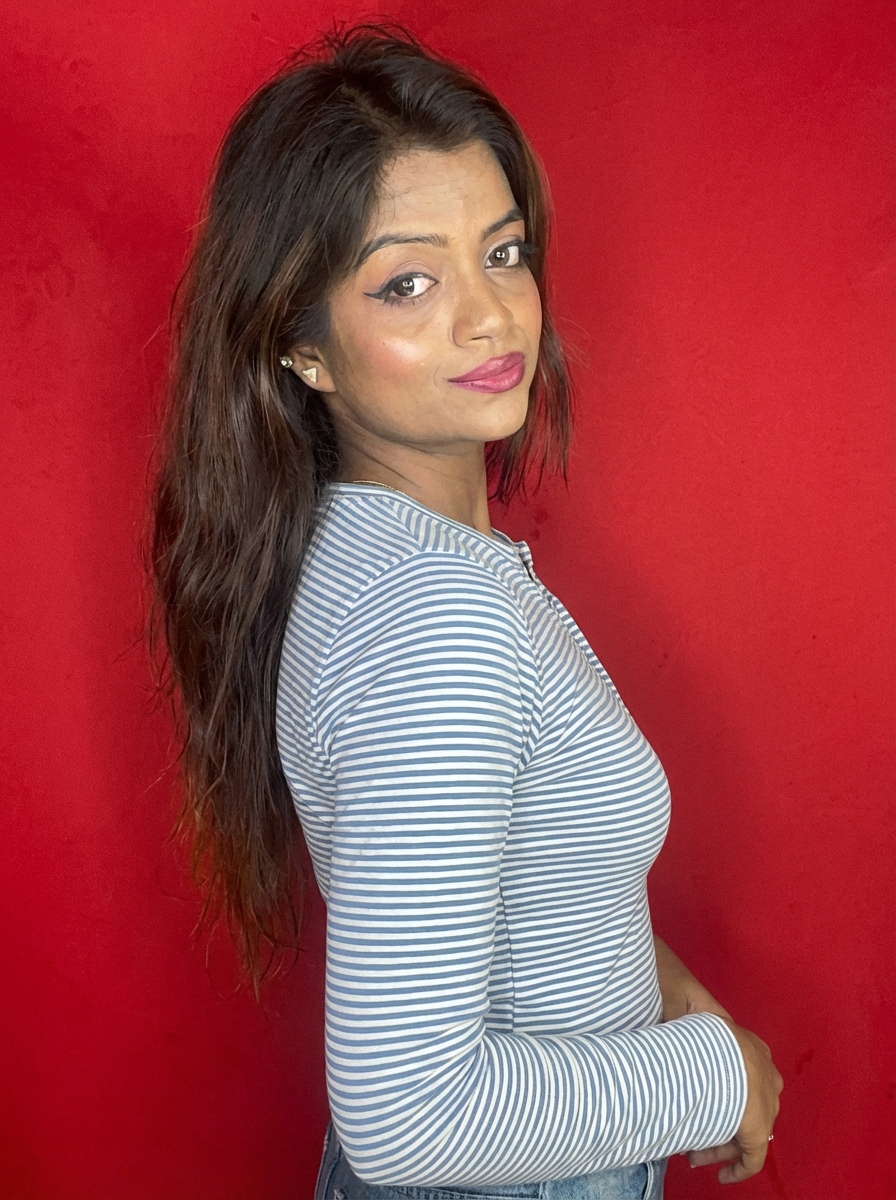
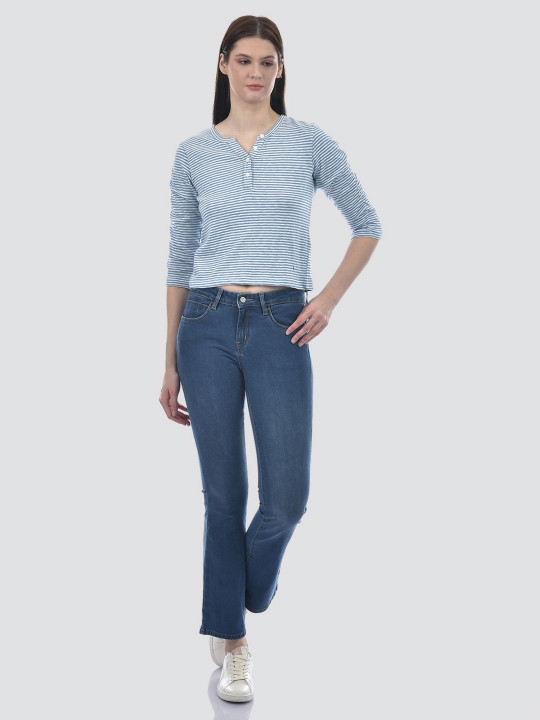
- **Fabric Physics:** The source garment is a cotton-jersey blend Henley top. It has a matte finish with low reflectivity. The physics simulation must treat it as a soft, pliable material with medium weight—it should not hang stiffly like starch, nor flow like silk. It requires soft fold generation where the fabric compresses.
- **Key Features:** The horizontal blue and white striping pattern is the critical texture element; geometric consistency must be maintained during the perspective shift from front-view to side-profile. The center-front button placket (Henley style) and the crew neckline are essential details. The hemline appears slightly cropped and un-hemmed or roll-hemmed.
PHASE 2: FIT & DRAPE SIMULATION
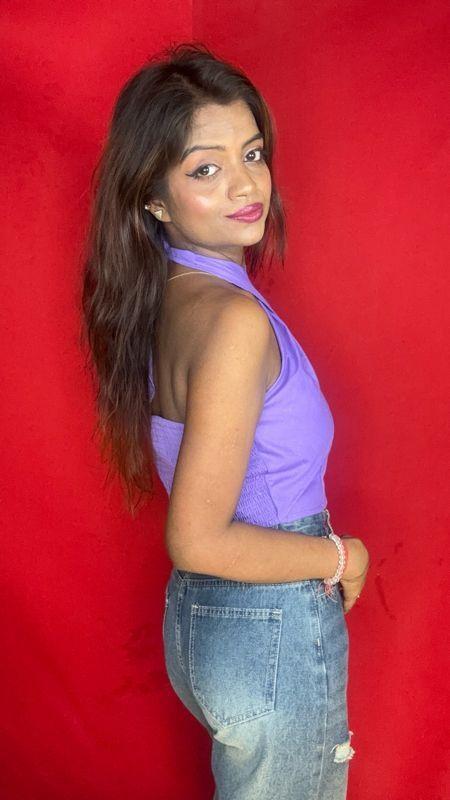
- **Body Mapping:** Because the user is in a side-profile pose, the source garment (long sleeve) must be generated to cover the entire bare arm and shoulder exposed by the current halter top. The stripes must wrap cylindrically around the torso and arm to imply volume. The fabric should generate tension wrinkles at the armpit and compression folds at the inner elbow where the user's arm is slightly bent. The hemline should hover near the waistband of the jeans, potentially interacting with the denim texture.
- **Occlusion Handling:** The user's long hair falls heavily over the left shoulder and upper arm. This is a critical occlusion layer. The hair mask must be segmented and composited *over* the new striped shirt. The bracelet on the left wrist will likely be covered by the long sleeve; however, if the sleeve rides up, the bracelet must create a bump or displacement in the fabric.
PHASE 3: ENVIRONMENT & LIGHTING
- **Light Match:** The user is illuminated by a direct, somewhat harsh frontal flash or strobe, creating a specular highlight on the cheek and shoulder. The new garment must render with high contrast: bright highlights on the shoulder and outer arm (facing the camera) and deeper shadows on the side of the torso facing the red background.
- **Color Calibration:** The source garment is cool-toned (blue/white), while the target environment is dominated by a saturated red background. The simulation must apply a subtle red color cast (ambient occlusion) to the edges of the white stripes where they recede away from the camera to simulate light bounce from the red wall, ensuring integration.
PHASE 4: IDENTITY PROTECTION
- **Facial Lock:** The user's entire facial profile, including the jawline, nose, lips, and ear, must remain pixel-perfectly frozen. The hairline and the volume of the hair must not be altered.
- **Body Integrity:** Strict prohibition on altering the user's arm width or waist circumference. The new garment is a "regular fit" and should add slight volume on top of the user's skin, rather than warping the user's underlying anatomy to fit the source image's silhouette.