Thinking Process
PHASE 1: VISUAL DECONSTRUCTION
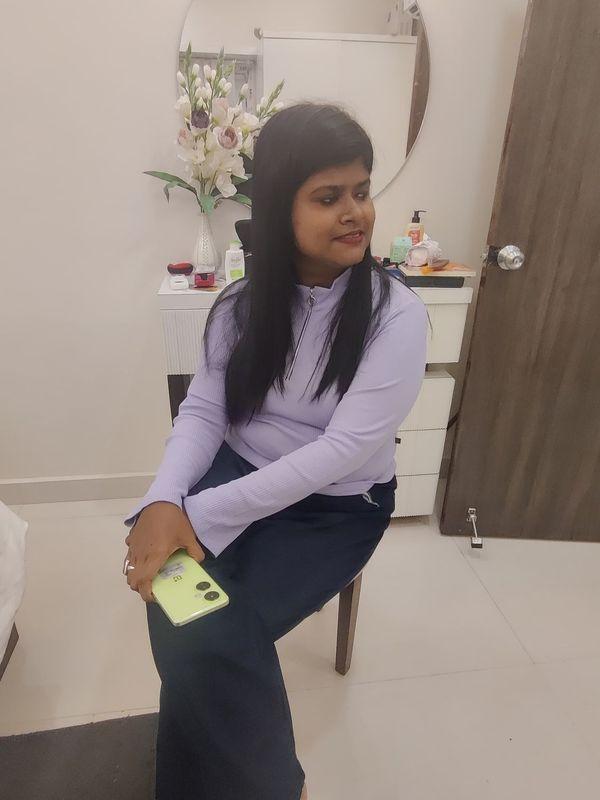
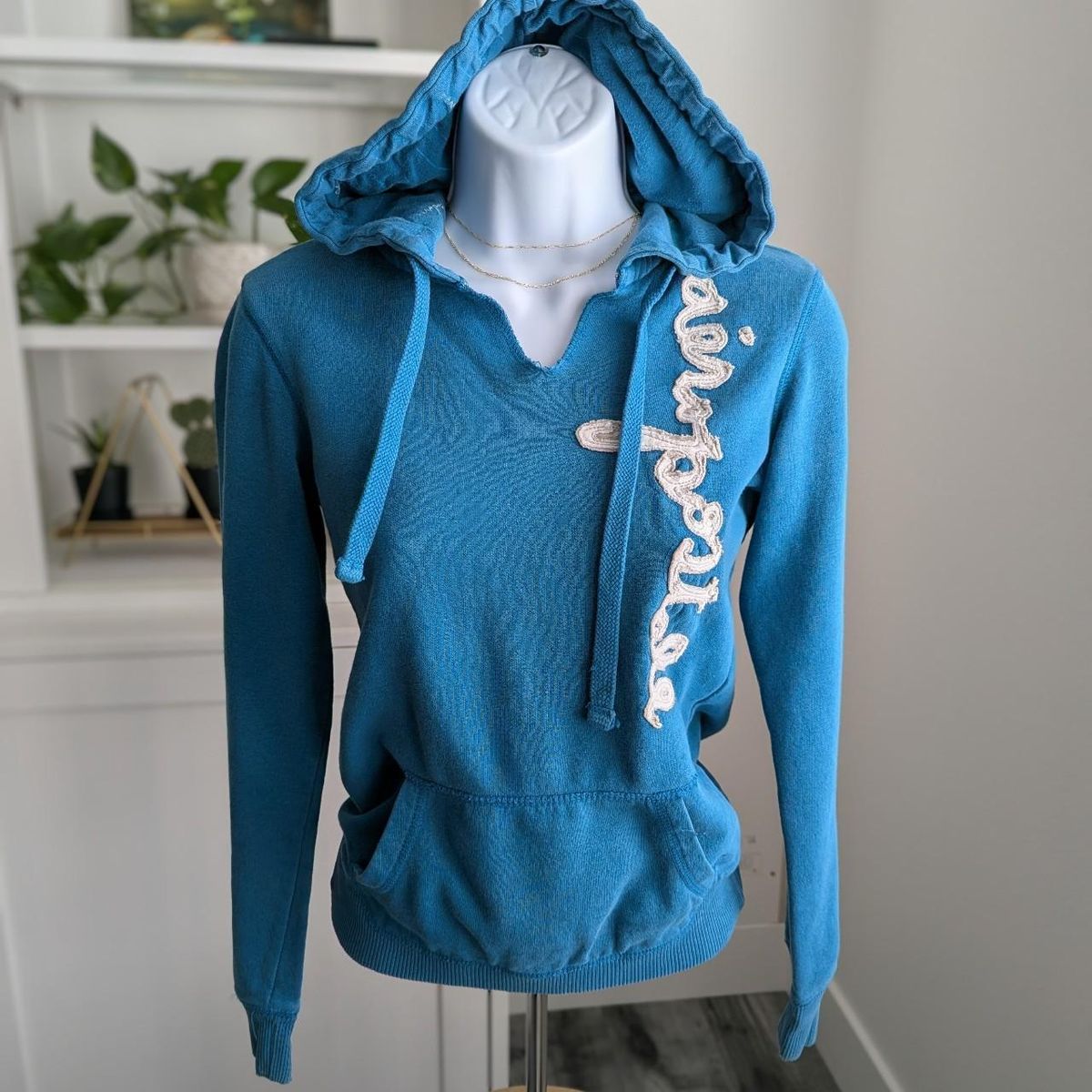
- **Fabric Physics:** The source garment is a cotton-polyester blend fleece (hoodie material). It has a matte finish with high light absorption, unlike the slight sheen of the user's current ribbed synthetic top. It possesses medium weight and structural stiffness; it will not cling to the skin like the current top but rather create its own volume and soft, rounded folds.
- **Key Features:**
- The **vertical "Aeropostale" appliqué** with cursive embroidery on the left chest/torso is the primary visual anchor and must retain its 3D texture.
- The **kangaroo pocket** at the lower front.
- The **ribbed cuffs and hemline**, which provide constriction points distinct from the main body fabric.
- The **drawstrings** and the **v-split neckline** construction.
- The **hood** (currently raised on the mannequin) must be digitally simulated in a "down" position to rest naturally around the user's neck.
PHASE 2: FIT & DRAPE SIMULATION
- **Body Mapping:**
- **Sitting Physics:** Since the user is seated, the hoodie will not hang straight. The fabric must bunch and fold horizontally across the midsection (stomach area) where the torso compresses.
- **Shoulder Volume:** The hoodie has a relaxed fit compared to the user's current tight top. The silhouette at the shoulders and upper arms must be expanded slightly to account for the thicker fleece material.
- **Hem Interaction:** The ribbed hem will rest on the user's upper thighs/lap, likely curving upward slightly due to the sitting position rather than hanging straight down.
- **Occlusion Handling:**
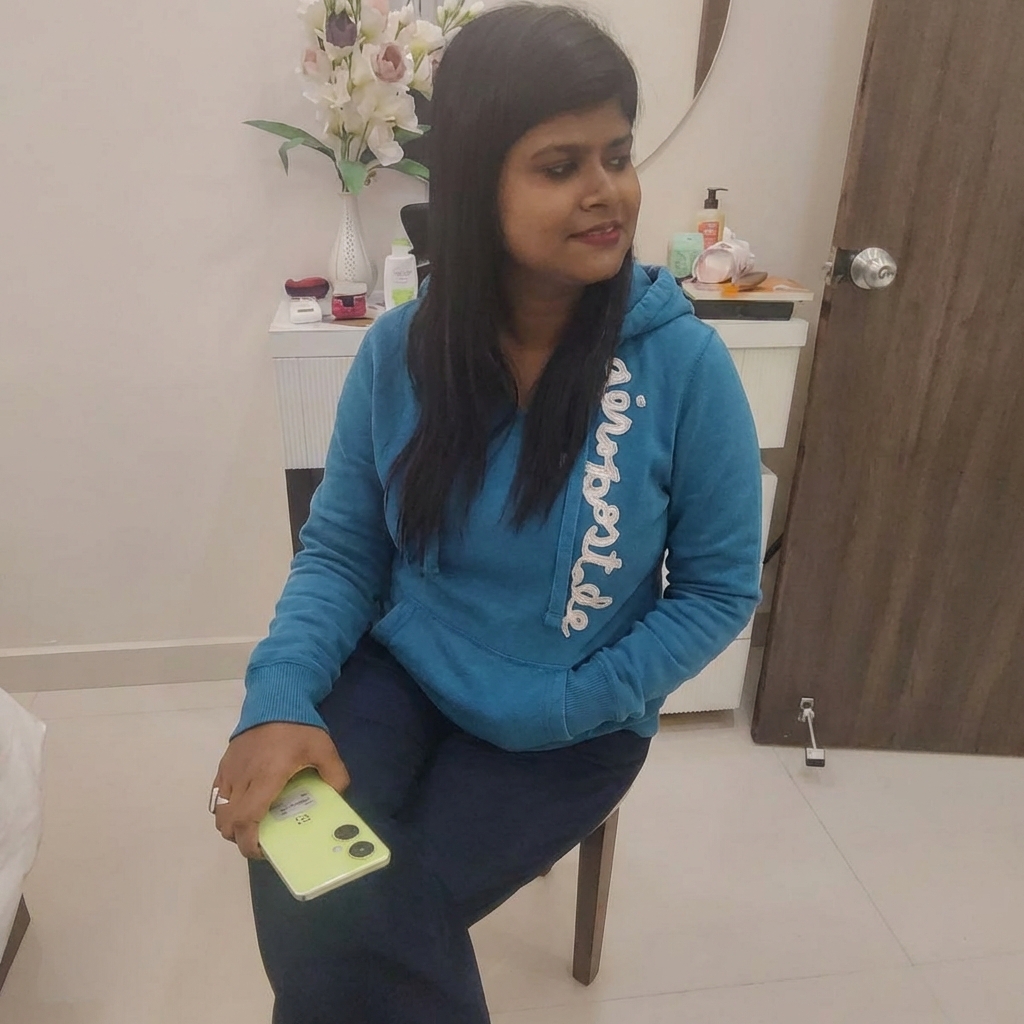
- **Hair Layering (Critical):** The user has long, dark hair flowing over both shoulders and the chest. The hoodie fabric must be generated *behind* the hair strands. The hair tips must cast soft shadows onto the teal fabric.
- **Hand & Object:** The user's right hand and the lime-green smartphone are resting on the lap. These pixels must be strictly preserved and layered *over* the hoodie's kangaroo pocket area.
- **Left Arm:** The left forearm rests on the leg; the hoodie sleeve must deform appropriately at the elbow and wrist, stopping before the hand.
PHASE 3: ENVIRONMENT & LIGHTING
- **Light Match:**
- The user is in an indoor environment with soft, diffused artificial lighting (likely warm white) coming from above and slightly in front (vanity mirror).
- The source image has high-contrast, cool studio lighting. The teal color of the hoodie must be color-graded to be slightly warmer and less saturated to match the indoor ambient occlusion of the user's room.
- Shadows must be generated inside the v-neck, under the drawstrings, and beneath the bust line to match the direction of the shadows on the user's face.
- **Color Calibration:** The bright white embroidery on the hoodie will likely reflect the ambient room color (slightly yellowish/warm) rather than remaining pure studio white.
PHASE 4: IDENTITY PROTECTION
- **Facial Lock:** Absolute freeze on the user's facial features, jawline, and skin tone. The neck area visible above the v-neck of the hoodie must remain the user's original skin.
- **Body Integrity:** Do not slim the user. The simulation must respect the user's seated posture. Since the hoodie is bulkier than the original top, the final output should actually show a slightly larger upper-body silhouette to reflect the garment's thickness, rather than artificially slimming the waist.