Thinking Process
PHASE 1: VISUAL DECONSTRUCTION
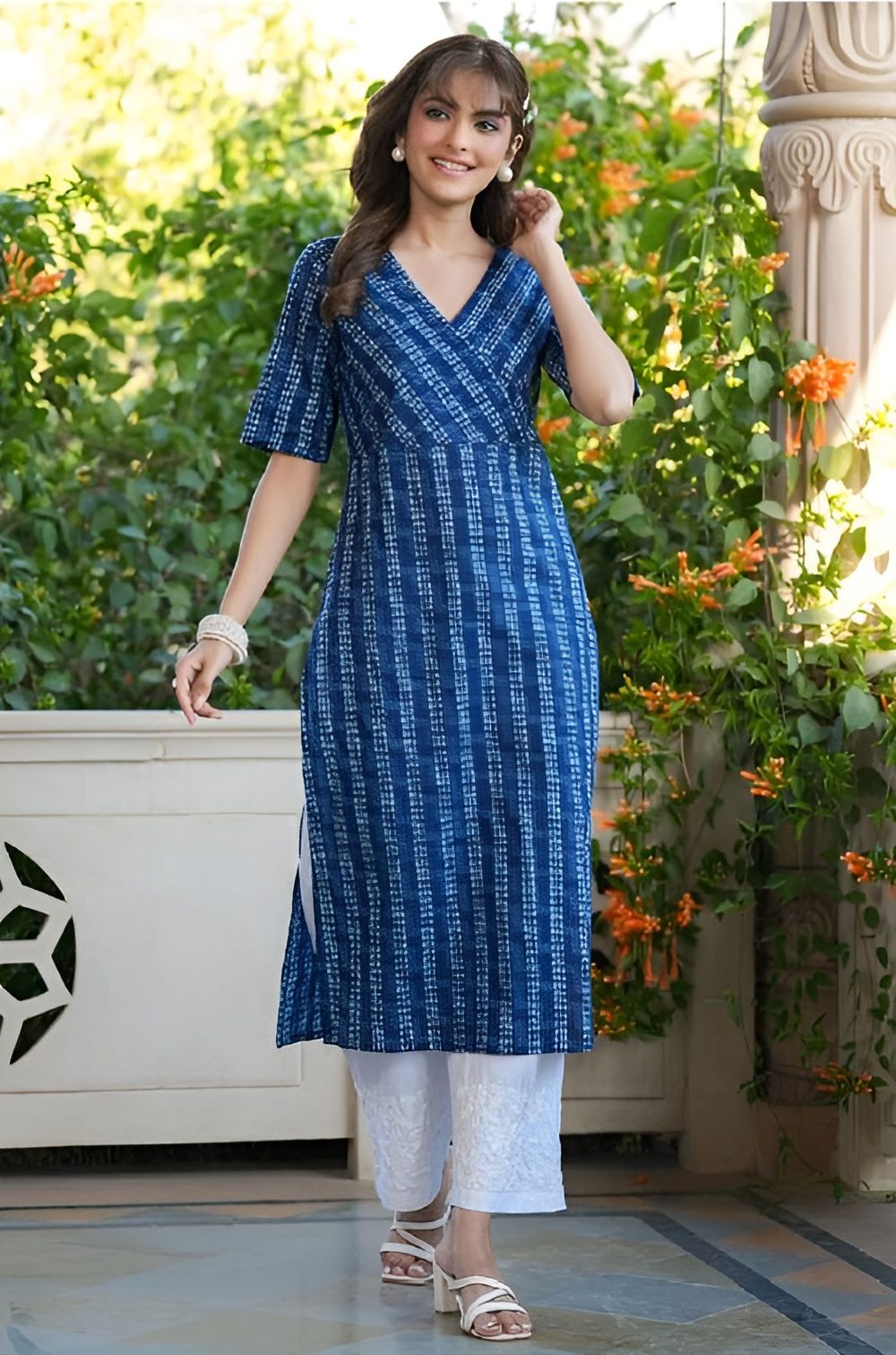
- **Fabric Physics:** The source material appears to be an Indigo-dyed cotton or cotton-linen blend. It possesses a matte finish with low specularity (no shine). The physics simulation must treat this as a semi-structured fabric—it holds its shape better than silk but is softer than denim. It requires a "crisp" drape simulation where folds are angular rather than fluid.
- **Key Features:**
- **Patterning:** The vertical white Shibori/tie-dye geometric lines must remain aligned vertically on the torso, distorting naturally only at the waist pinch points.
- **Neckline:** The V-neck wrap (Angrakha style) construction must be preserved.
- **Sleeves:** The sleeves are half-length (hitting just above the elbow).
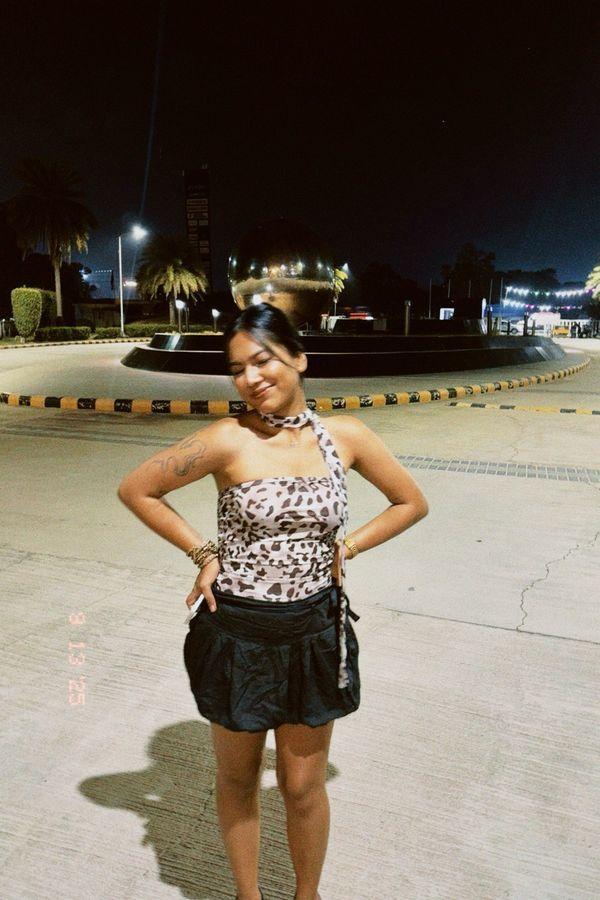
- **Silhouette:** This is a Kurta (tunic), meaning it extends below the hips. It must not be cropped to the waist; it should flow down to mid-thigh or knee level, effectively replacing the current mini-skirt in the rendered area.
PHASE 2: FIT & DRAPE SIMULATION
- **Body Mapping:**
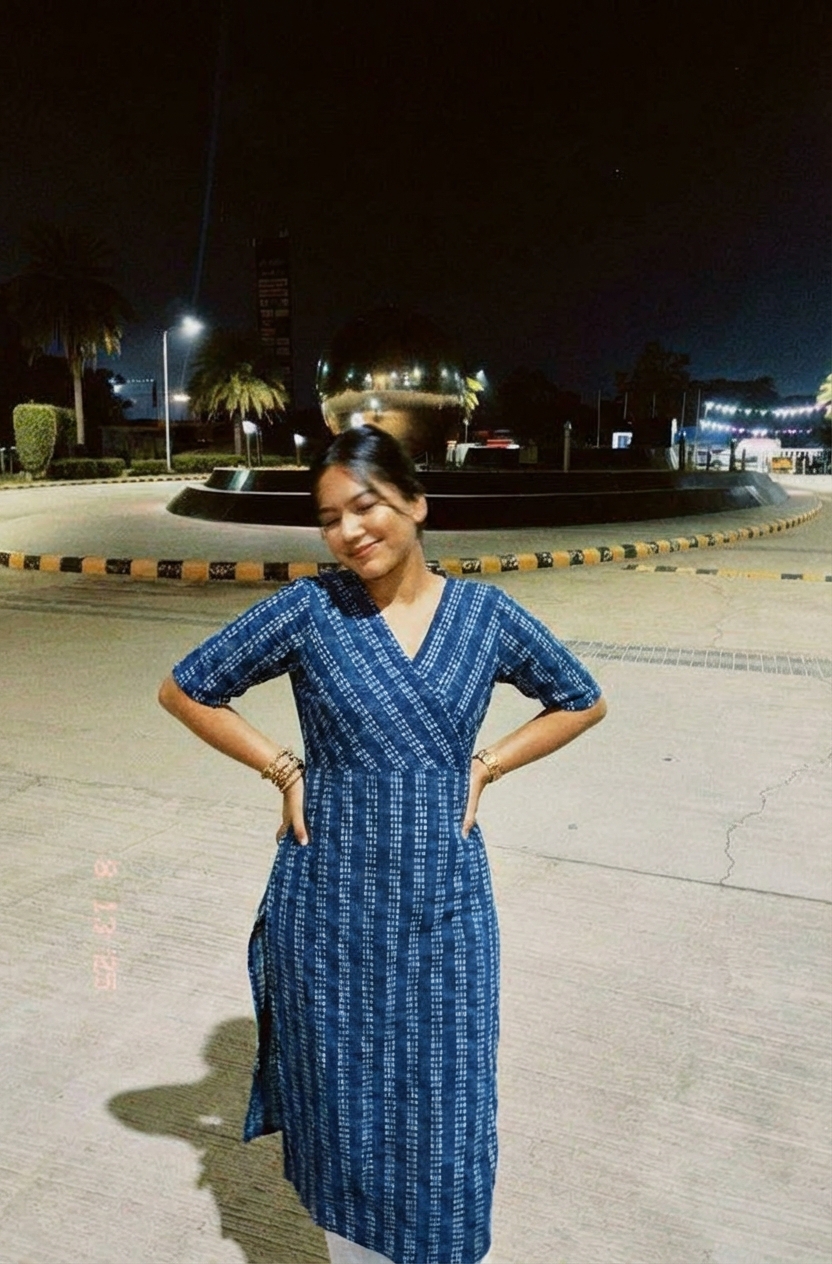
- **Torso Interaction:** The user is in an "akimbo" pose (hands on hips). The Kurta is a straight-cut garment. Therefore, the fabric must simulate "bunching" and compression around the waist where the hands press into the body.
- **Lower Drape:** Unlike the source image where the garment hangs straight, the user's flared hips and pose will cause the lower half of the Kurta to flare slightly outward. The fabric must drape *over* the user's existing skirt volume (if visible) or replace it entirely.
- **Shoulders:** The user has a slight head tilt; the garment neckline must align with the clavicle angle, not the image frame.
- **Occlusion Handling:**
- **Hands & Wrists:** The user's hands and gold bracelets are positioned *on top* of her current waistline. The new garment must pass *behind* these hands. The simulation must create a "mask" for the hands and wrists to ensure the fabric tucks underneath them realistically.
- **Neck/Choker:** The user is wearing a fabric neck scarf/choker that matches her old top. This must be **removed** digitally to expose the skin for the Kurta's V-neckline.
- **Tattoo:** The tattoo on the right bicep is likely to be partially or fully covered by the Kurta's half-sleeve. If the sleeve rides up, the tattoo must be preserved on the skin layer.
PHASE 3: ENVIRONMENT & LIGHTING
- **Light Match:**
- **Source vs. Target:** The source is soft, diffused daylight. The target is harsh, nighttime flash photography.
- **Shadow Rendering:** We must generate hard, high-contrast shadows. The flash originates from the camera angle, meaning the center of the chest should be the highlight point (hotspot), with rapid light fall-off towards the ribs and back.
- **Cast Shadows:** The user's hands must cast sharp shadows onto the new fabric where they touch the waist. The chin should cast a hard shadow onto the V-neck area.
- **Color Calibration:** The Indigo blue of the source garment must be color-graded to react to the cooler, artificial night lighting. The white patterns should not look warm/creamy (as in the source) but should reflect the cooler temperature of the flash (slightly bluish-white). The black levels of the garment folds must match the deep blacks of the background environment.
PHASE 4: IDENTITY PROTECTION
- **Facial Lock:** The user's entire head (hairline to chin), including the facial expression (closed eyes, smile) and the specific lighting on the face, must remain pixel-perfectly frozen.
- **Body Integrity:** The user's shoulder width and arm volume must not be altered. The simulation must not slim the waist to fit the garment; rather, the garment must expand to fit the user's waist and hip measurements defined by the image. The skin tone on the arms and upper chest (revealed by the V-neck) must match the user's original complexion exactly.